You are viewing : Home » Shop » Magic Accessories/ Clamps » Magic Dust Collector for Polishing Machine

Share this on FacebookShare this on TwitterShare this on Google +
Magic Dust Collector for Polishing Machine
Click for larger image and other views

Magic Dust Collector for Polishing Machine

By Red Technologies  Ref: DC500

Magic Dust Collector for Polishing Machine

MAGIC-DC500 (Dust Collector)


* The dust collector is optional.

1 Specifications

ItemMAGIC-DC500
Dimensions320 mm(W) x 565 mm(H) x 417 mm(D)
12.6”(W) x 22.2” (H) x 16.4” (D)
Power InputAC 220–240 V, 50/60 Hz
AC 100–120 V, 50/60 Hz (USA and Japan)
Max Suction Motor Output500 W
Average Power Consumption350 W
Weight28.5 Kg
62.8 lbs
Dust Collection Port DiameterØ75 mm / Ø3”
Airflow184 CFM
FilterFilter bag pore size: 25 μm
HEPA Filter: ≥99.97% at 0.3 μm

1.2 Standard Accessories

NamePhotoQty.Purpose
Dust Collection Hose1.5 MConnects the polishing machine to the external dust collector and carries dust and compound residue generated during operation to the collector.
Band Clamp2 EASecures the dust collection hose firmly to the dust collection port.
Power Cord1 EAConnects the dust collector to an AC outlet to supply operating power.

1.3 Other Optional Accessories and Consumables

NamePhotoPurpose
Taper SpindleAllows a buffing wheel to be screwed directly onto the tapered threaded section for quick installation and replacement.

* Taper Spindle Wrench: 19 mm (3/4")
Dust Port FilterPrevents relatively large debris, such as loose buff threads or dropped workpieces, from entering the dust collection port.
Bag FilterPrimary filter that captures incoming dust and reduces the dust load reaching the downstream HEPA filter.
HEPA FilterHigh-efficiency secondary filter that captures fine dust passing through the bag filter and reduces fine-particle discharge to the outside.
Hand Port CurtainCovers the chamber hand opening to reduce the escape of dust and compound residue during operation.

1.4 Dust Collector Connection

• Check the rear dust collection hose port for damage, obstruction, or foreign material.
• Push the dust collection hose fully onto the hose port and secure it firmly with a band clamp so it cannot come loose during operation.
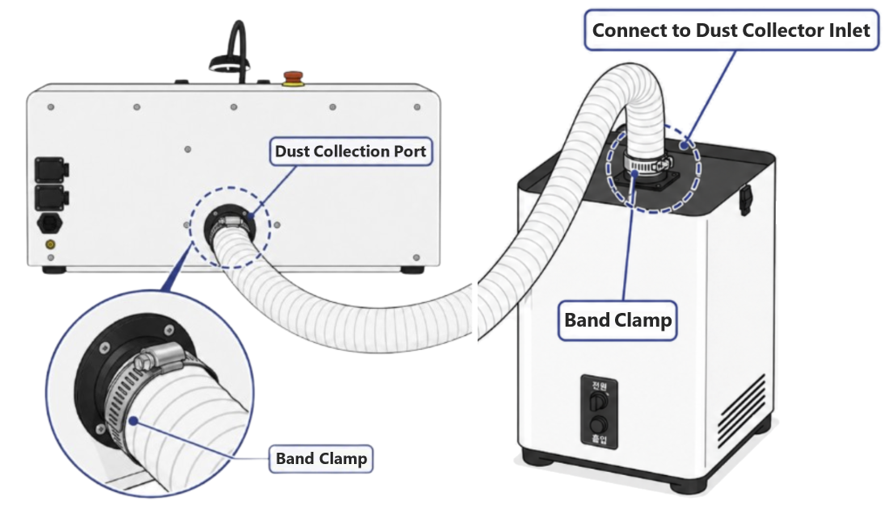
• Route the dust collection hose so it is not sharply bent, kinked, or crushed and airflow remains unobstructed.
• Make sure the dust collector filters are correctly installed and in serviceable condition.
• Run the dust collector and confirm normal suction at the internal dust ports. If necessary, adjust the left and right dust port shutters to provide suitable suction at the active work position.